RAG vs. Fine-Tuning: Choosing the Right Approach for Your LLM
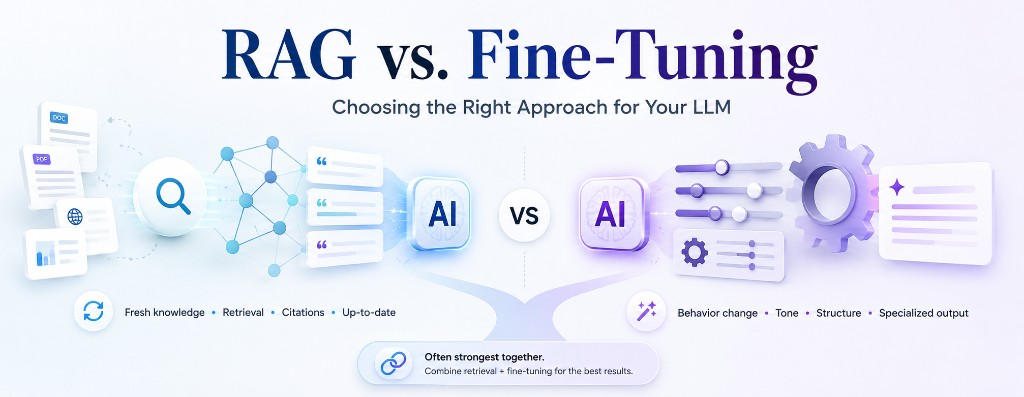
One of the most common questions we hear from clients building with large language models is whether they should fine-tune a model or use retrieval-augmented generation (RAG). The honest answer is that they solve different problems, and most production systems end up using both.
RAG keeps your knowledge outside the model. You store your documents in a vector database, retrieve the most relevant passages at query time, and pass them to the model as context. This is the right choice when your information changes frequently, when you need citations, or when you simply have too much knowledge to bake into model weights.
Fine-tuning changes the model's behaviour. It is the right tool when you need a specific tone, a structured output format, or a skill the base model performs poorly. Fine-tuning does not reliably teach a model new facts; that is what RAG is for.
Our default recommendation for most teams is to start with RAG plus careful prompt engineering. It is faster to ship, easier to debug, and keeps your data fresh. Reach for fine-tuning only once you have hit a clear ceiling that prompting and retrieval cannot break through.