The Real Cost of Hiring Locally Isn't Just the Salary
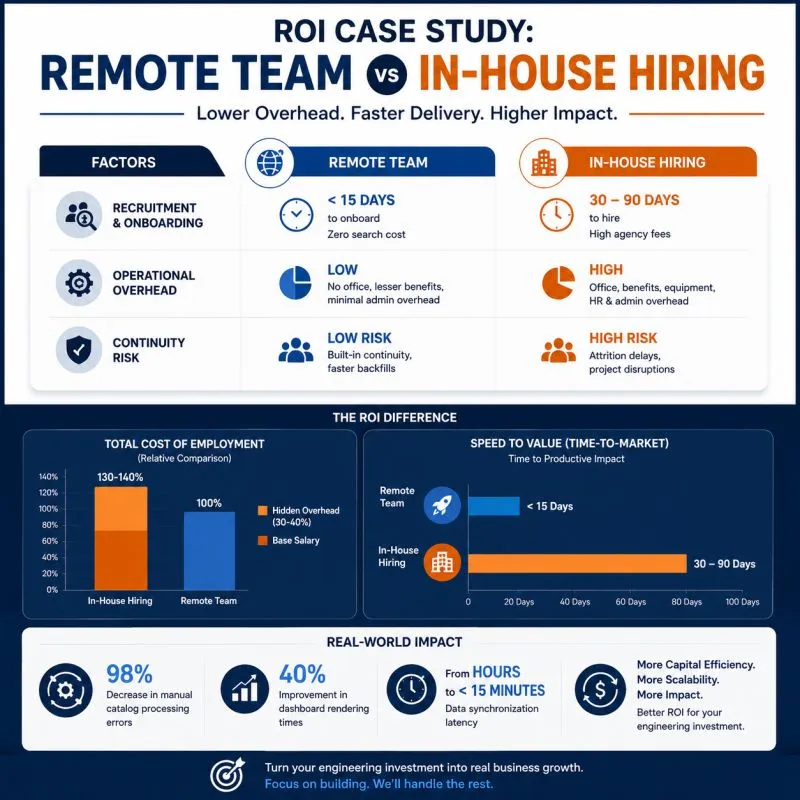
The real cost of hiring locally isn't just the salary.
It's the additional 30–40% overhead that comes with office operations, recruitment cycles, benefits, equipment, HR management, and employee turnover.
For many software companies, that hidden cost becomes a major obstacle to scaling engineering teams efficiently.
When founders and CTOs compare traditional in-house hiring with a well-structured remote engineering team, the ROI becomes much clearer.
Here's what we consistently see:
In-House Hiring vs Remote Engineering Teams
Recruitment Speed Local hiring can take 30–90 days plus recruiter fees. Remote teams can often be onboarded in under 2 weeks with pre-vetted engineers.
Operational Overhead Office space, local benefits, equipment, and administrative management significantly increase the real cost per engineer.
Continuity & Stability Turnover in competitive local markets can delay projects for months. Distributed engineering teams provide faster replacements and stronger delivery continuity.
Faster Time-to-Market
In software development, speed matters.
Remote engineering teams help companies bypass local talent shortages and scale quickly with experienced specialists in backend engineering, cloud infrastructure, automation systems, database optimization, and modern frontend development.
Real Operational Impact
By focusing engineering resources on product delivery instead of operational overhead, teams can achieve measurable improvements:
- 98% reduction in manual catalog processing errors through automation pipelines
- 40% faster dashboard and reporting performance after database optimization
- Data synchronization times reduced from hours to under 15 minutes
The biggest advantage of remote engineering isn't simply lower cost.
It's flexibility, scalability, and the ability to invest more of your resources directly into product growth.
How is your team optimizing engineering efficiency and technical runway in 2026?